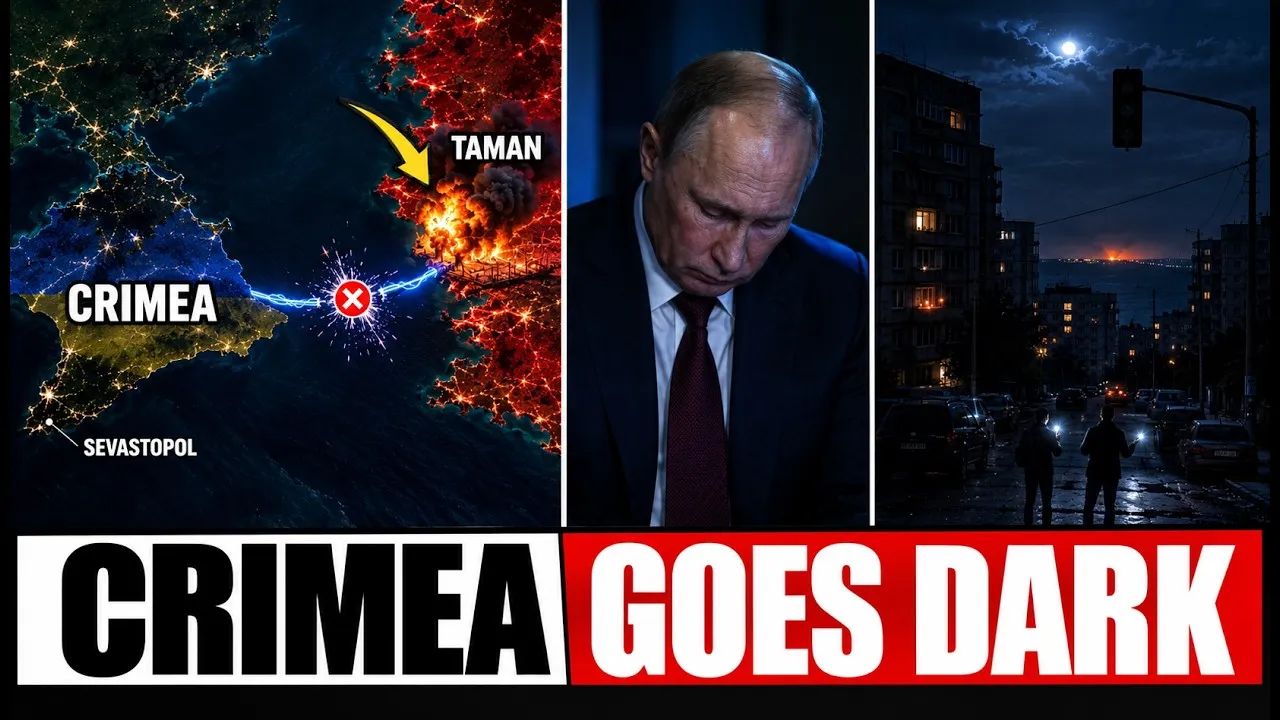
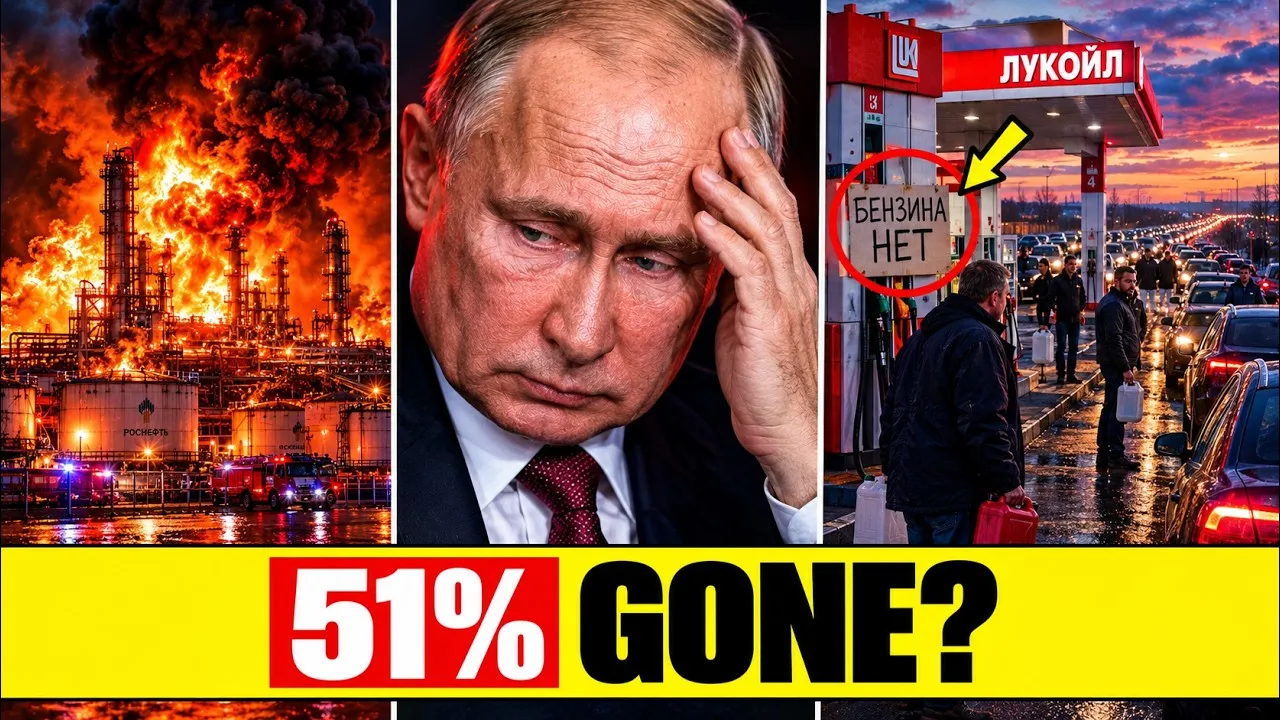
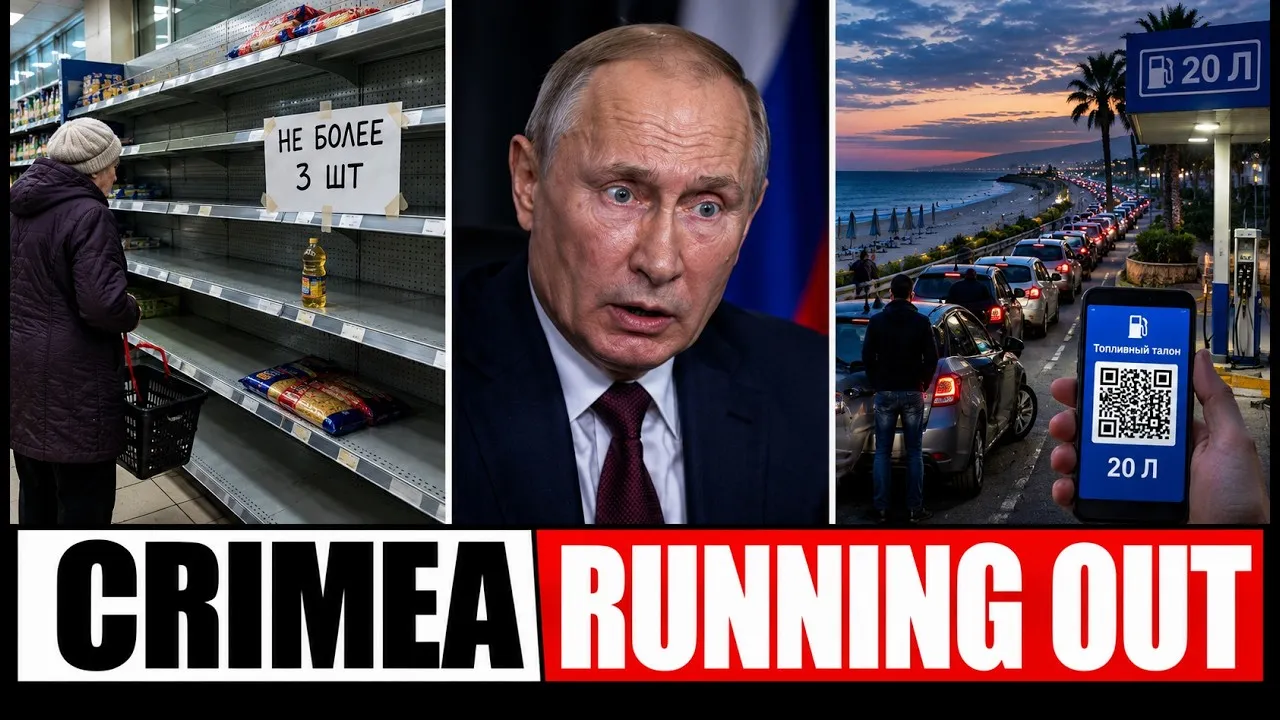
Crimea is running out of everything: fuel by QR code, empty beaches and hours without power
In occupied Crimea, petrol is rationed by QR code, food prices have jumped and whole towns spend hours without electricity. This is what Ukraine's pressure on every route into the peninsula looks like at the other end – in the shops, petrol stations, homes and hotels.

 Illustration
Key points
- In Sevastopol, drivers need a QR code to buy 20 litres of petrol a week; black-market petrol reportedly cost more than five times its pre-crisis price.
- Russia's own statistics service recorded a 211% year-on-year rise in Crimean petrol prices in July, against 26% across Russia. CONFIRMED – Confirmed: backed by at least two independent, reliable sources or by direct evidence.
- After the July blackout, electricity use fell 42% and night-time lights 83%, according to independent data.
- Tourist bookings fell 58–72% and nearly 400 restaurants and cafés closed in the first half of 2026, NV reports.
- Nobody outside the occupation authorities knows how many people have left Crimea, and we will not guess.
Watch the video
At a petrol station in Sevastopol, you can no longer just pull up and fill your tank. First you need a QR code. Then you get 20 litres – not 20 litres a day, but 20 litres a week per vehicle, according to the Ukrainian outlet NV. Source [1]
If the station is empty, there is another option. In early August, NV reported that a litre of 92-octane petrol on the black market in Crimea cost 450 roubles. Before the crisis began this spring, it cost about 80. Source [1] That is more than five times the price of the fuel that moves every car, bus, delivery van and generator on the peninsula.
And fuel is only where it starts. In the shops there are purchase limits on cooking oil and pasta. At home there are hours without electricity. In some villages, water arrives by tanker lorry. On the beaches that Moscow once promised would be packed with Russian tourists, bookings have collapsed.
This is life inside occupied Crimea in the autumn of 2026 – a territory the Kremlin spent twelve years presenting as Russia’s safe, sunny showcase, now living on rations.
What holds Crimea up
When Russia annexed Crimea in 2014, it promised that the peninsula would be richer, safer and better supplied as part of Russia than it ever was as part of Ukraine. To keep that promise, Moscow built the Kerch Bridge, laid a power cable under the Kerch Strait, and later opened a land corridor through occupied southern Ukraine.
Every litre of fuel, every bag of flour and every spare part that Crimea does not make itself has to arrive by one of those routes: the bridge, the ferries, the road and rail corridor through Rostov and the occupied south, and the power cable. In 2026, Ukraine went after all of them at once – refineries, the railway drawbridge over the Don at Rostov, ferries and tankers in the Kerch Strait, the bridges between Kherson region and Crimea, and the substation that feeds Crimea’s power cable.
One warning first. Crimea is an occupied territory where independent journalism is not allowed. Much of what follows comes from Ukrainian sources, anonymous residents and Russian official data. Each figure says where it comes from, and where nobody really knows, we say so.
Fuel
In early June, according to the Kyiv Post, citing posts by the occupation authorities, purchases of A-95 petrol in Crimea were limited to 20 litres a day. Source [2] On 4 June, cash sales of petrol were suspended; fuel was sold only to people holding ration coupons, and soon the coupons themselves became scarce.
By August, Ukraine’s military intelligence, the HUR, said petrol reached most stations only once every few days and queues stretched for more than a kilometre, as reported by the Ukrainian news agency UNN. The HUR said A-95 cost 269 roubles a litre at the pump and up to 300 from resellers. Source [3] CLAIMED – Claimed: stated by a government, army or official, but not independently verified.
Russia’s own statistics point the same way. According to NV, Rosstat, Russia’s state statistics service, recorded that petrol prices in Crimea rose 211% year-on-year in July, against 26% across Russia as a whole. Source [4] CONFIRMED – Confirmed: backed by at least two independent, reliable sources or by direct evidence. Petrol prices in Crimea rose about eight times faster than in the rest of Russia.
The supply problem starts far from the peninsula. In June, Ukrainian media reported that fuel deliveries to Crimea were disrupted after strikes on oil infrastructure in Novorossiysk, the Russian Black Sea port across the water. Source [9] When a terminal on the mainland burns, the queue in Simferopol grows a few days later.
Moscow responded on 4 August. NV reports that Vladimir Putin announced a fuel subsidy and the official price fell to 100 roubles a litre. But a lower price does not help if the fuel is not there: NV reported that after the subsidy, fuel had still not returned to the stations. Source [1]
The Kremlin’s view? On 28 June, Putin described the fuel shortage as “some, but not critical”. His spokesman, Dmitry Peskov, repeated that line on 16 July. CLAIMED – Claimed: stated by a government, army or official, but not independently verified.
Food
In June, Ukraine’s Centre for Countering Disinformation said sugar, flour, cereals, salt, pasta and cooking oil were disappearing from Crimean shops, and that some retail chains in Sevastopol had introduced purchase limits – three bottles of cooking oil and three packets of pasta per customer in some supermarkets. The Kyiv Post, which reported the statement, did not independently verify it. Source [2] UNVERIFIED – Unverified: reported, but we could not check it. Treat with caution.
Here again, the price data tells the story. NV reports that food prices in Crimea rose by about 30% on average and that inflation on the peninsula reached 15.8%, against about 6% nationally. Source [1] One source cited by Ukrainian media put food price rises at 40 to 50%.
Some Crimeans have found their own solution. According to Krym.Realii, the Crimea service of Radio Free Europe, residents have started driving across the Kerch Bridge to the Kuban region on the Russian mainland just to buy groceries, where food costs between a third and a half less. Small shop owners make the trip too, and it still pays after the cost of travel. Source [5]
The shortages are worst away from the big cities. In the northern town of Dzhankoi, wholesalers were struggling to deliver goods to shops at all because of the fuel shortage, Ukrainian media reported. In villages near Bakhchysarai, power was cut for hours every day – in some for so long that residents could not keep their fridges running. Imagine buying food you cannot keep cold, at prices 30% higher than last year.
The occupation authorities say they are watching prices and have capped the mark-up on some essential goods at 5%. But a cap on profit margins does not create supply. One retailer explained the real problem in a single line: lorries can no longer use the Kerch Bridge, and carriers refuse trips because the alternative route is considered dangerous. That alternative is the land corridor through the occupied south, where Ukrainian drones have been hunting supply lorries all year.
Electricity
The biggest shock to daily life this year was not fuel or food. It was electricity.
On 6 July, according to the Moscow Times, Krymenergo, the Russian-installed power company, announced that the whole of Crimea had lost power overnight, blaming “external interference”. Source [6] CONFIRMED – Confirmed: backed by at least two independent, reliable sources or by direct evidence. According to NV, it was the first time Crimea had lost power completely. Hospitals and emergency services kept their electricity, and by the afternoon power was partly back in the south and east.
Eight days later, on 14 July, the Balaklava power plant near Sevastopol stopped after a strike. NV says it provided up to a third of Crimea’s local generation. Source [1] Ukraine’s military intelligence estimated that at the height of the July blackout about 1.4 million customers were without power at the same time. CLAIMED – Claimed: stated by a government, army or official, but not independently verified.
Independent data backs up the scale. NV cites the independent Russian outlet The Bell, which reported that electricity consumption in Crimea from 1 to 20 July was 42% lower than a year earlier. Source [7] Satellite images showed night-time lights over Crimea down 83% compared with April.
Sevastopol moved to a schedule of two hours with power and six hours without. NV reports that in the northern towns of Armiansk and Krasnoperekopsk, outages lasted up to a month. Source [1]
Then, on 19 July, the occupation authorities simply stopped publishing lists of outages. Sergei Aksyonov, head of Crimea’s Russian-installed administration, explained why: “We are restricting information in the public domain.” That sentence may be the most honest statement any Russian official has made about Crimea this year.
It is not over. On the night of 23 October, the lights went out across Crimea again after a reported strike on the Taman substation that feeds the power cable from Russia.
Winter and water
NV has made a calculation. In January, Crimea’s power demand is about 1,780 megawatts. The Tavrida power plant near Simferopol can produce about 470. If the Balaklava plant stays offline and the cable keeps being hit, NV estimates that Crimea’s own generation would cover less than half of what it needs in winter. Source [1] That is NV’s calculation, not an official one, but it explains why residents are worried about heating.
When the power goes, the water often goes with it, because pumps run on electricity. An anonymous resident told NV that some villages receive water by tanker once a day and that the central supply may run for two or three hours a day, or not at all. That is one person’s account. UNVERIFIED – Unverified: reported, but we could not check it. Treat with caution. But on 13 August, Russia’s own consumer health watchdog, Rospotrebnadzor, acknowledged substandard water quality in Yevpatoria, Krasnoperekopsk, Saky, Dzhankoi and Armiansk, and in three northern and western districts. CONFIRMED – Confirmed: backed by at least two independent, reliable sources or by direct evidence.
Hospitals have been given generators, NV reports, but not enough of them. During the 24 October blackout, hospitals and social services switched to backup power – and generators need diesel, which brings everything back to fuel.
Tourism and business
Crimea’s authorities had forecast a 20% rise in tourist arrivals this year. Instead, according to NV, data from the Russian booking platform TravelLine showed bookings down between 58 and 72%, depending on the month. Source [1]
Restaurants and cafés felt it first. Ukraine’s military intelligence and NV both report that almost 400 food-service businesses closed in the first half of 2026; NV puts the figure at 398, which it says is 42% more than a year earlier. NV also reports that about a third of small business owners plan to close or sell. Source [1]
Industry is stalling too. NV reports that Crimean Titan, the big chemical plant in Armiansk, has been idle since June; a dairy plant in Dzhankoi stopped in August; and a soda plant put its workers on leave at a third of their pay.
The housing market, which boomed after 2014 as Russians bought holiday flats and retirement homes by the sea, has turned. NV reports that demand fell by up to 30% and the average price per square metre dropped from 180,000 roubles to 130,000. Source [1] People who invested in Crimea’s future as a Russian resort have watched that investment lose more than a quarter of its value in a single year.
How many people have left?
A viewer asked how many people have left Crimea this year. The honest answer is that nobody outside the occupation authorities knows, and they are not saying.
The Institute for the Study of War reported in June that Russian tourists, residents, military personnel, staff linked to the Black Sea Fleet and representatives of the occupation authorities were leaving the peninsula, and that this outflow could have short-term demographic consequences. Source [8] But ISW gave no numbers. NV quotes an anonymous source who says some Russians who moved to Crimea after 2014 are trying to send their wives and children to the Russian mainland, and notes that no representative surveys were carried out in Crimea in 2025 or 2026. Source [1]
People are leaving, tourists are not coming, and housing demand is falling. But any precise figure for how many have left would be a guess, and we will not present a guess as a fact.
How the authorities handle the anger
Not by listening. NV reports that police detained 29 people in Krasnoperekopsk over a call for a rally, a collective appeal from 2,500 workers at a fuel company, and arrests over critical social media posts. Source [1] Crimean Solidarity, a group that supported the families of detained Crimean Tatars, stopped operating in July after being designated a “foreign agent”.
Ukraine’s military intelligence makes a more serious claim. According to UNN, the HUR says men in the Dzhankoi district have been required to confirm their military registration before receiving compensation for lost electricity and water, and that women with medical training face a similar requirement. Source [3] It has not been independently verified. UNVERIFIED – Unverified: reported, but we could not check it. Treat with caution. If true, hardship is being used as a tool of mobilisation.
In July, the Kyiv Post reported a claim by the Ukrainian partisan group Atesh that the Kremlin planned to remove Aksyonov after Russia’s September elections and blame him for the crisis. Source [2] As of late October there is no sign that has happened, and the claim remains unverified. UNVERIFIED – Unverified: reported, but we could not check it. Treat with caution. But Aksyonov has reportedly been publicly threatening local officials who failed to help residents, which suggests he feels the pressure.
Moscow’s side
The Kremlin’s line is that the problems are temporary and the shortages not critical. It has offered fuel subsidies, price caps and generators, and after each blackout the occupation authorities report that power has been restored. It is true that Crimea has not collapsed: people still go to work, shops still open, and the lights do come back, at least for a few hours.
The Kremlin also blames Ukraine directly – every outage is “an enemy attack” – and argues that Ukraine is hurting civilians. There is a real point inside that argument. The people of Crimea include hundreds of thousands of Ukrainians and Crimean Tatars who never chose Russian rule, and they live through the same blackouts, queues and water shortages as everyone else.
Ukraine’s answer is that Crimea has been turned into a military base: its military intelligence says the crisis comes from the militarisation of the peninsula and Russia’s war, and that normal life can only return after de-occupation. Ukraine also points out that Russia has struck Ukraine’s own power grid far more heavily, for far longer. Both things can be true at once.
What it means
This is our view, not a fact. Crimea was supposed to be Putin’s proof that Russian rule brings stability and prosperity. That story is now very hard to tell. Rationed fuel, a collapsing tourist season and an administration that refuses to publish outage lists are not what a secure, prosperous region looks like.
But this is not a guaranteed win:
- Sources. Most detailed figures come from Ukrainian sources and anonymous residents. Russian official data, such as Rosstat’s prices and Rospotrebnadzor’s water warnings, supports the general picture, but not every detail.
- Hardship can harden attitudes. Moscow can use the suffering of Crimea’s residents in its own propaganda.
- Russia adapts. Subsidies, imports through the Kuban, generators and repairs can keep the peninsula running at a lower level for a long time.
- Winter cuts both ways. Ukraine’s own cities face the same cold, and Russia’s strikes on Ukraine’s grid are heavier.
What to watch next
- Fuel coupons. If Crimea returns to normal sales, supply is recovering. If coupons and QR codes stay through the winter, the squeeze is working.
- The winter power gap. Whether the Balaklava plant comes back online, and how often the Taman substation and the Kerch cable are hit.
- Aksyonov. If the Kremlin replaces the head of Crimea, it will be the clearest admission yet that Moscow knows the crisis is real.
Sources
- NV (Ukrainian outlet), “Reporting on fuel rationing, prices, power, tourism and business closures in Crimea”.
- Kyiv Post, “Reporting on fuel limits and shop purchase limits”.
- UNN (Ukrainian news agency), citing Ukraine's military intelligence (HUR), “Reports on petrol queues, prices and registration requirements”.
- Rosstat (Russia's state statistics service), via NV, “Petrol price data for Crimea”.
- Krym.Realii (RFE/RL's Crimea service), “Reporting on residents shopping on the Russian mainland”.
- The Moscow Times, “Report on the Crimea-wide blackout”, .
- The Bell, via NV, “Data on electricity consumption in Crimea”.
- Institute for the Study of War (ISW), “Assessment on people leaving Crimea”.
- Ukrainian media compiling local reports, “Reports on deliveries, outages and hospitals on backup power”.