Crimea goes dark: how Ukraine is trying to turn the peninsula into an island
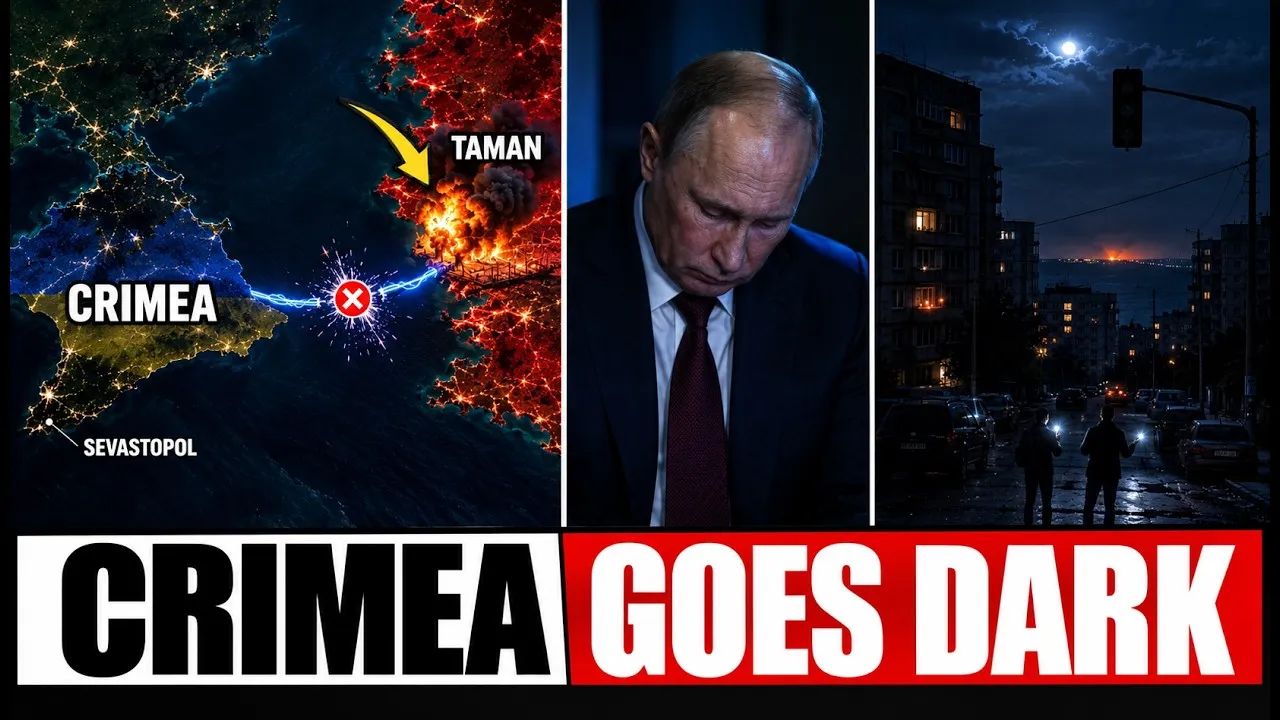
On the night of 23 October, the lights went out across occupied Crimea after a strike on a substation on the Russian mainland. It was the latest blow in a year-long campaign against every line into the peninsula: power, fuel, rail and ferries.

 Illustration
Key points
- At least 11 Crimean cities lost power on 23 October; Sevastopol's Russian-installed governor confirmed an outage in his city.
- NASA fire data showed damage at the Taman substation, the gateway for the power Russia sends into Crimea under the Kerch Strait.
- The same substation has been reported hit four times in eight months, and the cable's landing station in Crimea was struck twice in July. CLAIMED – Claimed: stated by a government, army or official, but not independently verified.
- Blackouts mean rotating power cuts, internet outages and hospitals on generators – and a fuel problem, as generators need diesel.
- Ukraine's commanders say the aim is cost, not a ground offensive: every blackout forces Russia to choose what to protect.
Watch the video
On the night of 23 October, the lights went out across occupied Crimea. Simferopol went dark, then Sevastopol, Yalta, Feodosia, Kerch, Dzhankoi, Yevpatoria, Alushta, Sudak, Armiansk and Krasnoperekopsk – at least 11 cities and dozens of towns and villages, according to reports compiled by Ukrainian media from local monitoring channels. Source [2] One monitoring channel put it in six words: “The entire peninsula is without electricity.”
Sevastopol’s Russian-installed governor, Mikhail Razvozhayev, did not deny it. On Telegram he wrote that “as a result of an enemy attack on energy infrastructure outside of Sevastopol, our city is temporarily without power”. CONFIRMED – Confirmed: backed by at least two independent, reliable sources or by direct evidence.
Outside Crimea, in fact. According to the Kyiv Independent, NASA satellite fire data showed damage at the Taman substation in Russia’s Krasnodar region, on the mainland side of the Kerch Strait. Source [1] That single substation is the gateway for the electricity Russia sends into Crimea. When it fails, the peninsula feels it within minutes.
Not a one-night event
Crimea was only the most visible part of that week. The same night, explosions, a fire and a power cut were reported in Rostov-on-Don, and preliminary reports said drones hit a synthetic rubber plant in Tolyatti, in Samara region. Source [2] On the night of 20 October, the Kyiv Independent reported a mass drone attack on energy infrastructure in occupied Chystiakove in Donetsk region, a strike on a telecoms site in occupied Luhansk, and drones near the railway station in Krasnoperekopsk in northern Crimea, followed by power cuts. Source [1] On 18 October, monitoring channels reported hits on an oil terminal, a data centre belonging to the Russian tech company VK, and a bridge in St Petersburg.
Most of these reports come from monitoring channels and have not been independently confirmed. UNVERIFIED – Unverified: reported, but we could not check it. Treat with caution. But the direction is clear: power, fuel, data and bridges, night after night, hundreds of kilometres behind the front line. Crimea sits at the end of all of those lines.
The goal, in the words of Ukraine’s own commanders, is to turn Crimea into an island.
One cable, two ends
To understand why one substation can switch off a peninsula of more than 2 million people, go back eleven years. In November 2015, the transmission towers that carried electricity from mainland Ukraine into Crimea were blown up in Kherson region. Crimea, annexed by Russia the year before, went dark and lived for weeks on generators and rolling blackouts.
Moscow’s answer was a cable: an “energy bridge” under the Kerch Strait from Russia’s Kuban region to the eastern tip of Crimea, made of four underwater power lines, as Ukraine’s military news agency Army Inform describes it. Source [5] It solved one problem and created another. Crimea no longer depended on Ukraine for electricity, but a large part of its power now came through one narrow corridor, through a small number of facilities on each side.
On the Russian side, that corridor runs through Taman. According to the Ukrainian defence outlet Militarnyi, the Taman substation is a 500/220-kilovolt trunk substation in Russia’s unified grid, and all four lines of the energy bridge pass through it. Source [3] On the Crimean side, the cables come ashore at a transition station near the village of Hlazivka on the Kerch Peninsula, where the electricity moves onto overhead lines across Crimea.
Two ends, one cable. That is the choke point – and in 2026, Ukraine went after both ends.
The strikes on Taman
- 27 February: according to Militarnyi, 13 drones hit the substation and partially disabled it. Source [3]
- 20 March: satellites detected several fires. Russian officials said 40 firefighters and 13 fire engines put out the blaze and, as usual, blamed falling drone debris. Russia’s Defence Ministry said it shot down 26 Ukrainian drones that night. CLAIMED – Claimed: stated by a government, army or official, but not independently verified.
- 20 August: Euromaidan Press reports that drones hit both the Taman oil and gas terminal and the substation. NASA fire sensors recorded fires, and a peninsula-wide blackout was reported early that morning. Source [4]
- 23 October: the latest blackout.
That is four times in eight months, if the reports are correct, at the same substation on the same corridor. CLAIMED – Claimed: stated by a government, army or official, but not independently verified.
The other end of the cable
On 8 July, Ukraine’s Unmanned Systems Forces struck the transition station at Hlazivka. Their commander, Robert Brovdi, known by his call sign “Madyar”, called it the key entry point of electricity into Crimea from Russia. According to United24 Media, the same operation hit five more substations, three radar stations and a training ground. Source [6] Brovdi said his drone units hit 50 energy facilities in Crimea and the occupied south in the first eight days of July alone. CLAIMED – Claimed: stated by a government, army or official, but not independently verified.
Four days later, on the night of 12 to 13 July, they came back. Ukrainska Pravda reports that drones struck the power bridge and 11 energy facilities, including nine substations, the Hlazivka transfer point and a gas pumping station. Source [7] Brovdi named the operation “Crimean Switch-off and Air Defence Fall”.
The strait itself was under attack in the same days. United24 Media reports that Brovdi’s forces hit nine tankers from Russia’s shadow fleet in the Sea of Azov, and that over 72 hours 19 tankers, a cargo vessel and a ferry were hit in the Kerch area, as part of a 40-day operation led by Ukraine’s security service, the SBU. Source [6] CLAIMED – Claimed: stated by a government, army or official, but not independently verified.
These are Ukrainian military claims, and the outlets that reported them did not independently confirm the damage. But the target list shows the plan: not one big strike on one bridge, but pressure on every way across the water at once. Brovdi then made a promise: “A deep and total blackout for the occupiers is inevitable.”
Power made in Crimea
The cable is only half of Crimea’s power. The other half comes from the peninsula’s own gas-fired power plants. The two biggest, Balaklava near Sevastopol and Tavrida near Simferopol, were built after the annexation. Euromaidan Press notes that both use Siemens turbines moved to Crimea in breach of EU sanctions, a scandal that broke in 2017. Source [4]
In June, those plants became targets too. On 20 June, satellite sensors logged a thermal anomaly at the Tavrida plant during an attack. According to Euromaidan Press, on 24 June drones went after the Balaklava plant and all of Sevastopol went dark, with roughly half of Crimea already without power. Source [4] Two days later, on 26 June, the occupation authorities declared a regional state of emergency across Crimea and Sevastopol. CONFIRMED – Confirmed: backed by at least two independent, reliable sources or by direct evidence.
By midsummer, Russia was losing power at both ends of the cable and inside the peninsula at the same time.
What a blackout means
On 21 August, after another night of strikes, Krymenergo, the Russian-installed power company, admitted that several settlements had lost electricity after what it called mass Ukrainian attacks. Sevastopol’s power company introduced a rotating schedule that the Kyiv Post described as “2 through 6”: two hours with power, then up to six hours without, rotated across four groups of customers. Source [8] Imagine running a hospital, a bakery, a water-pumping station or a mobile phone mast on that schedule.
The internet goes with the power. On 24 October, the Kyiv Independent reported widespread internet outages across Crimea, citing the monitoring group NetBlocks. Source [1] Hospitals and social services switched to backup generators. Power came back in stages in Yalta, Gurzuf, Alushta and parts of Simferopol – and then Simferopol and Yalta went dark again because the grid was too unstable to hold. Source [2]
Crimea’s occupation head, Sergei Aksyonov, has said the authorities are limiting what they tell residents. That alone says something about the scale of the problem.
Electricity is not the only thing running short. In June, the Russian-installed governor announced a total halt to petrol sales on the peninsula after weeks of drone strikes on supply routes, according to RFE/RL. Source [9] Petrol, rail, ferries and now power: everything Crimea needs has to come across the strait or down the land corridor through Rostov – and every one of those lines is under attack. The railway drawbridge over the Don at Rostov, on the main rail route south towards Crimea, was hit on 10 October; United24 Media reported that around 25 trains were delayed. Source [6]
The military logic
Robert Brovdi argues that cutting the power leaves Russian forces blind, because much of Russia’s air defence in Crimea runs on the grid. CLAIMED – Claimed: stated by a government, army or official, but not independently verified. It cannot be independently checked, but it explains the name of his July operation. In that operation, Ukrainska Pravda reports, Brovdi claimed hits on five air-defence elements, naming an S-400, a Pantsir-S1, a Tor and a Nebo-U radar. Source [7] CLAIMED – Claimed: stated by a government, army or official, but not independently verified.
The logic is simple. Radars, command posts, communications, repair workshops and fuel depots all need electricity. Generators can replace the grid for a while, but generators need diesel – exactly what Russia is now short of. The International Energy Agency says Russian diesel output is down nearly 30% this year, and Russia banned diesel exports for the first time in July. A blackout in Crimea is not only a power problem; it is a fuel problem too.
The aim is cost, not conquest
Ukraine’s defence minister, Mykhailo Fedorov, has said, in Euromaidan Press’s paraphrase, that Ukrainian forces are turning the peninsula into an island. Source [4] The SBU has vowed to make Crimea “a zone of constant losses” until Russian troops leave.
But here is the honest part. Ukraine’s commander-in-chief, Oleksandr Syrskyi, frames this year’s aim as defensive: exhausting the Russian army, not retaking Crimea. Nobody in Kyiv is promising that the lights going out in Sevastopol means Ukrainian troops will walk in next month.
The point is cost. Every blackout forces Russia to choose. It can send more air defence to protect substations and power plants, but those systems then do not protect airfields, ammunition depots or the front line. It can repair the damage again and again, but every repair crew, transformer and cable has to come across the same strait that is under attack. Or it can accept rolling blackouts in a territory Moscow has spent eleven years presenting to Russians as a safe, prosperous holiday destination.
The strikes do not need to destroy Crimea’s grid. They only need to make it unreliable – and unreliable is expensive.
There is also the question of spare parts. A substation is a yard of transformers, switches, breakers and control systems. Small parts can be swapped quickly, but large high-voltage transformers are heavy, specialised equipment, generally built to order rather than kept on a shelf. That is a general feature of power grids everywhere, not a reported detail about Taman – none of the sources say what exactly was damaged on 23 October. But if a large transformer was hit, the repair is measured in weeks or months, not hours.
Moscow’s side
The Russian-installed authorities say the outages are temporary, and after the 24 October blackout they said power had been restored in several cities. Russia’s Defence Ministry, as always, says it shoots down most of the drones. On 21 August, Sevastopol’s governor claimed 19 drones intercepted, according to the Kyiv Post, without providing evidence. Source [8] CLAIMED – Claimed: stated by a government, army or official, but not independently verified.
It is true that the lights come back. Every blackout so far has been followed by repairs, some within hours. If the question is whether Crimea will stay permanently dark, the answer is almost certainly no. The better question is how many times the same substation can be hit before the repairs stop keeping up.
The human cost
The people of Crimea include Ukrainians and Crimean Tatars who never chose Russian rule. A blackout reaches their homes as well as Russian military bases. Russia’s Investigative Committee reported two people killed and several injured during the 21 August strikes; Ukraine did not comment, and the Kyiv Post could not verify the report. Source [8] UNVERIFIED – Unverified: reported, but we could not check it. Treat with caution.
Ukraine argues that it targets energy infrastructure because Russia uses it to supply its occupying army, and that Russia has spent years striking Ukraine’s own grid far more heavily. Both things can be true at once. Civilians on both sides of the strait are living with the consequences.
Confirmed, claimed and the risks
Confirmed: the Kerch energy bridge and the Taman substation are a single choke point for the power Russia sends into Crimea; that choke point has been reported hit repeatedly in 2026, and Russian-installed officials have themselves admitted outages after the attacks; and the blackouts are part of a wider squeeze on every line into Crimea.
Only claimed: the number of facilities Ukraine says it has hit, the effect on Russian air defence, and the full extent of the damage. On 23 October, the Kyiv Independent said it could not independently verify the extent of the blackout or the substation attack at the time of publication. Source [1]
The risks for Ukraine:
- Retaliation. Russia has struck Ukraine’s grid far more heavily. In mid-October all three of Kyiv’s combined heat and power plants were hit and 600,000 people lost power, according to the Kyiv Independent.
- Pressure from Washington. President Trump has asked Ukraine to stop striking Russian energy infrastructure, and a campaign against Crimea’s grid falls squarely into that category.
- Repair capacity. Russia can keep restoring power for a long time if the strikes are spread out. The campaign only works if it is sustained.
What to watch next
- Taman. Satellite imagery of the substation in the coming days. If the damage is heavy, Crimea’s rolling blackouts will last weeks, not hours.
- Outage schedules. If Sevastopol and Simferopol go back to “2 through 6”, the grid cannot carry the load – the clearest sign from Russia’s own utilities.
- Winter. Crimea’s heating, water pumping and hospitals all depend on electricity. If the strikes continue into November, the pressure on the occupation authorities will grow fast.
Sources
- The Kyiv Independent, “Reporting on the Crimea blackout, NASA fire data and NetBlocks internet outages”, .
- Ukrainian media compiling local monitoring channels, “Reports of outages across Crimea and strikes in Rostov and Tolyatti”, .
- Militarnyi (Ukrainian defence outlet), “Reports on the Taman substation and strikes on it”.
- Euromaidan Press, “Reports on strikes on Taman and on Crimea's power plants”.
- Army Inform (Ukrainian military news agency), “Reports on the Kerch energy bridge and the July strikes”.
- United24 Media, “Reports on the July operation around the Kerch Strait”.
- Ukrainska Pravda, “Reports on the 'Crimean Switch-off' operation”.
- Kyiv Post, “Reports on rotating power cuts in Sevastopol and the 21 August strikes”.
- RFE/RL, “Report on the halt to petrol sales in Crimea”.